- Home
- About Us
- CE Accreditation
-
CE Courses
- Nursing CE Courses
- Advanced Nursing Practice
- Critical Care Nursing
- Disaster and Terrorism Management
- Emergency Nursing
- Ethics, Legal and Advocacy
- Infection Control and Community Nursing
- Gerontology
- Leadership and Management
- Medical-Surgical Nursing
- Nursing Sciences
- Nursing Skills and Procedures
- Pediatric Nursing
- Perioperative Nursing
- Pharmacology
- Psychiatric / Mental Health
- State-Required Courses
- Teaching and Preceptorship
- CE Course Bundles
- Medical CME Courses
- Inservice Courses
- Nursing CE Courses
- CE Certification
- Resources
- FAQ
- Contact Us
Licensure Guide
Reactivating a Lapsed Nursing License in Florida
What Florida Nurses Need to Know About Inactive vs Lapsed Status, CE Requirements, and Common Pitfalls.
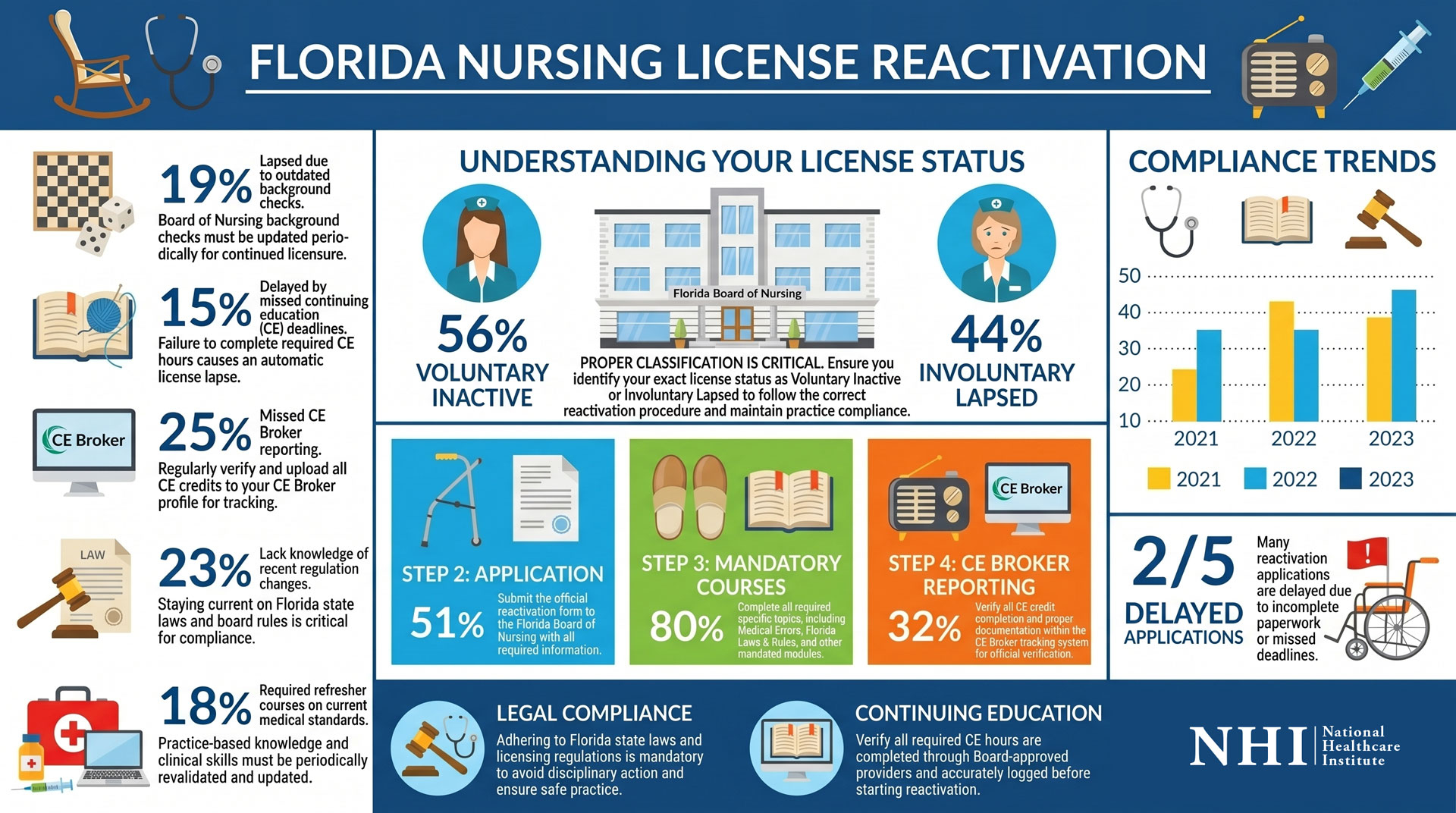
For many Florida nurses, life, career transitions, family responsibilities, or job changes can interrupt active practice. In some cases, licenses are intentionally placed on inactive status. In others, they lapse unintentionally due to missed deadlines or incomplete renewal requirements.
When it’s time to return to practice, confusion often arises about what steps are required to become licensed again.
Understanding the difference between an inactive license and a lapsed license in Florida is critical. Each status carries different regulatory requirements, continuing education (CE) obligations, and reactivation processes. Making the wrong assumption can delay reactivation, create compliance problems, or lead to practice restrictions.
Understanding License Status in Florida
Florida nursing licenses fall into distinct categories, each with different legal and regulatory consequences:
- Active
- Inactive
- Delinquent
- Lapsed
- Null/Void
Inactive License vs. Lapsed License: Key Differences
Inactive License
(Intentional Status)
An inactive license is a status a nurse voluntarily chooses. It means you intentionally placed it inactive through the Florida Board of Nursing.
- No active practice allowed
- No renewal obligation while inactive
- License remains on record
- Easier reactivation process
Lapsed License
(Unintentional Status)
A lapsed license occurs when a nurse fails to renew on time, CE is incomplete, or fees are unpaid. It is not a chosen status.
- License expires
- Practice becomes illegal
- Regulatory compliance actions required
- Reactivation is more complex
Legal Implications of Each Status
| Status | Can Practice? | Regulatory Risk | Reactivation Complexity |
|---|---|---|---|
| Active | Yes | None | None |
| Inactive | No | Low | Moderate |
| Lapsed | No | High | Higher |
| Delinquent | No | Moderate | Moderate |
| Null/Void | No | Severe | Very High |
Note: Practicing with a lapsed license is considered unlicensed practice and can trigger disciplinary action.
CE Implications for Reactivation
CE Requirements for Inactive Licenses
When a license is inactive, CE is generally not required during inactivity, and you are not actively reporting CE. However, CE is required for reactivation. To return to active status, nurses must:
- Complete required CE hours
- Complete mandatory topic courses
- Meet renewal compliance standards
- Submit reactivation applications and pay fees
CE Requirements for Lapsed Licenses
When a license lapses, CE compliance becomes retroactive. Renewal requirements are still enforced. Missing CE must be completed, and mandatory courses must be fulfilled.
In some cases, extra CE hours may be required, refresher courses may be mandated, remedial education may apply, or a Board review may occur.
CE Broker and Reactivation
Florida uses CE Broker as the official CE tracking system. For reactivation:
- CE must appear in CE Broker.
- Courses must be properly categorized.
- Providers must be state-approved.
Missing or misclassified CE credits can delay reactivation.
Common Pitfalls That Delay Reactivation
-
Confusing Inactive and Lapsed Status
Many assume “Inactive” = “Expired” or “Lapsed” = “Inactive”. They are legally different and regulated differently.
-
Completing the Wrong CE
Not all CE counts. Common mistakes include using non-Florida approved providers, out-of-state credits not recognized, or incorrect topic categorization.
-
Missing Mandatory Courses
Florida requires topic-specific CE (like Medical Errors, Laws & Rules). Missing even one can block reactivation.
-
Improper CE Reporting
Even completed CE is invalid if not reported to CE Broker, reported incorrectly, or not linked to your license number.
-
Waiting Until Employment Starts
Delaying reactivation until you get a job offer can cause employment delays, on-boarding problems, and credentialing issues.
Legal Risks of Practicing Without Reactivation
Practicing with a lapsed or inactive license may result in disciplinary action, fines, license suspension/revocation, or criminal liability. This applies even if you completed CE but didn't report it, or if you believed the license was active.
Planning Safe Reactivation
Florida’s renewal and reactivation system is compliance-based, not trust-based. Regulatory review depends on CE Broker records, provider approval, and reporting accuracy. This makes structured CE planning essential.
Best practices include:
- Verifying license status early
- Reviewing specific CE requirements for your status
- Completing mandatory courses first
- Using approved providers
- Confirming CE Broker reporting
Ready to Reactivate Your License?
Reactivating a nursing license in Florida is a regulatory process. Ensure your CE is accurate, approved, and properly reported to avoid delays.
Get the CE Bundle for ReactivationAll mandatory courses included. Auto-reports to CE Broker.
Contact Information
Location
Coral Gables, FL 33134Working Days/Hours
Mon - Fri / 9:00AM - 5:00PM