- Home
- About Us
- CE Accreditation
-
CE Courses
- Nursing CE Courses
- Advanced Nursing Practice
- Critical Care Nursing
- Disaster and Terrorism Management
- Emergency Nursing
- Ethics, Legal and Advocacy
- Infection Control and Community Nursing
- Gerontology
- Leadership and Management
- Medical-Surgical Nursing
- Nursing Sciences
- Nursing Skills and Procedures
- Pediatric Nursing
- Perioperative Nursing
- Pharmacology
- Psychiatric / Mental Health
- State-Required Courses
- Teaching and Preceptorship
- CE Course Bundles
- Medical CME Courses
- Inservice Courses
- Nursing CE Courses
- CE Certification
- Resources
- FAQ
- Contact Us
Mandatory Requirement
Prevention of Medical Errors CE for Florida Nurses
Complete Guide for License Renewal Compliance for RNs, LPNs, and APRNs.
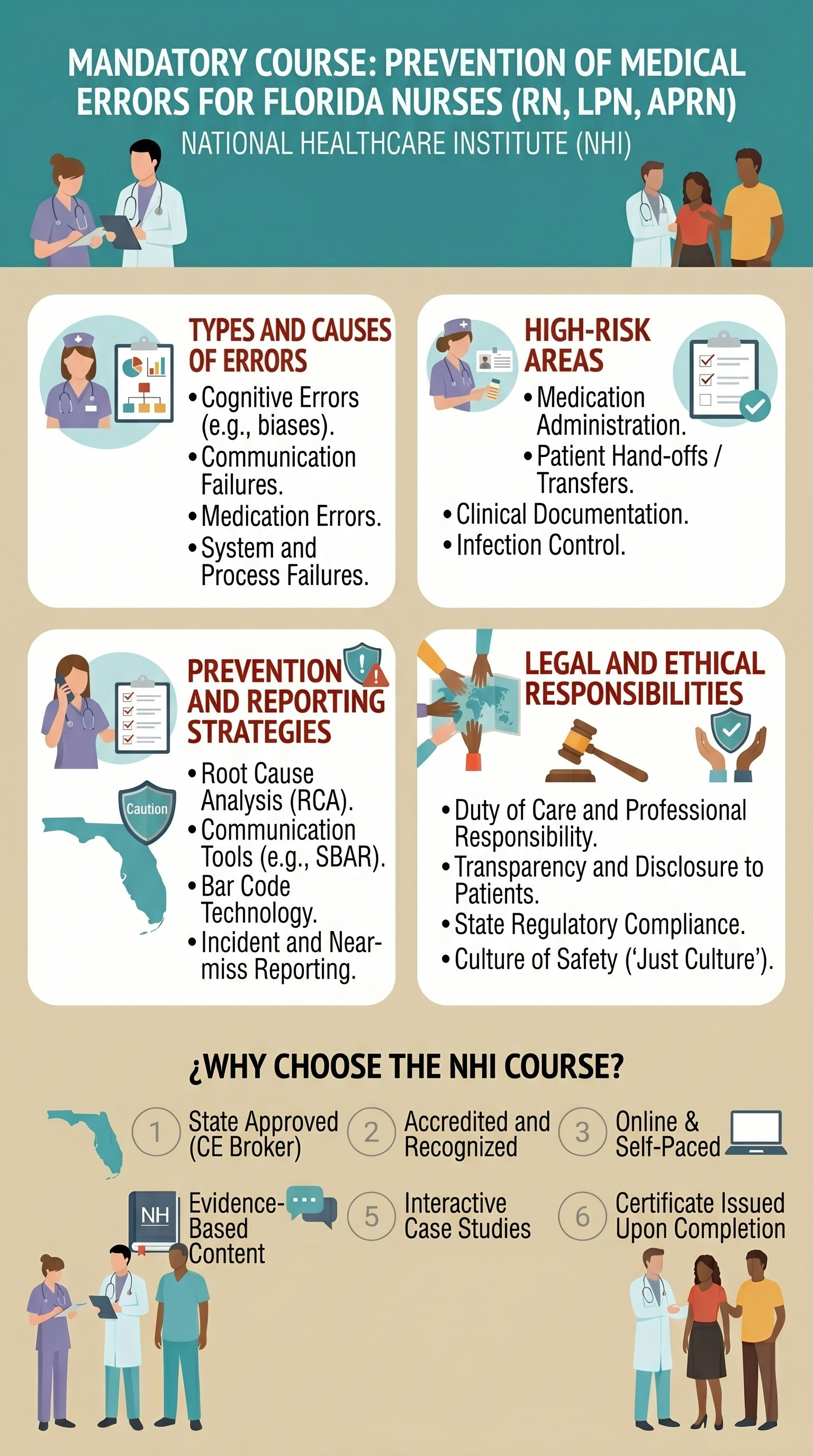
For Florida nurses, the Prevention of Medical Errors CE is not optional; it is a mandatory licensure requirement tied directly to patient safety, regulatory compliance, and license renewal eligibility.
Despite being one of the most well-known CE courses in Florida, it is also one of the most misunderstood. Many nurses are unsure about how many hours are required, who must take it, when it is due, and how it fits into the overall renewal cycle.
This guide provides a clear, authoritative breakdown of the Prevention of Medical Errors CE requirement in Florida, including why it exists, how many hours are required, when it must be completed, and the most common misconceptions that create unnecessary stress and compliance errors.
Hours Required
2 Contact Hours
Frequency
Every Renewal Cycle (2 Yrs)
Who Must Take It?
All RNs, LPNs & APRNs
Can it be waived?
No (Mandatory)
Why Prevention of Medical Errors CE Is Required in Florida
The Prevention of Medical Errors course is mandated by the Florida Board of Nursing as part of the state’s patient safety framework. The requirement exists to address preventable harm in healthcare systems, including:
- Medication errors
- Documentation errors
- Communication failures
- System-level breakdowns
- Clinical judgment errors
- Workflow and handoff failures
Rather than focusing only on individual mistakes, the course emphasizes systems-based safety, risk prevention, and structured clinical decision-making. The goal is to support safer care delivery, reduced sentinel events, and improved clinical outcomes across all practice settings.
How It Fits Into Florida License Renewal
Florida nurses must complete a combination of general CE hours and state-mandated specific-topic courses. The Prevention of Medical Errors course is one of Florida’s required topic-specific courses, meaning:
- You cannot substitute it with general CE
- You cannot waive it
- You cannot replace it with employer training (unless it is state-approved CE)
If this course is missing, your renewal is incomplete, even if you have more than enough total hours.
What the Course Covers
A compliant Prevention of Medical Errors course typically includes:
Patient Safety Foundations
- Human factors in healthcare
- Cognitive errors and clinical bias
- System-based failures and Workflow risks
Clinical Risk Areas
- Medication administration safety
- Documentation standards
- Handoff communication and Delegation errors
- Transitions of care and Diagnostic/assessment failures
Error Prevention Strategies
- Root cause analysis
- Standardization of protocols and Safety checklists
- Reporting systems and Interdisciplinary communication models
- Evidence-based safety frameworks
Common Misconceptions
Avoid these common traps that lead to compliance issues:
- Myth: “It’s optional if I have extra CE hours”False. It is a mandatory category requirement, not an optional elective.
- Myth: “Employer training counts”False. Only if the training is state-approved CE, issued by an accredited provider, and properly reported to CE Broker. Most internal hospital training does not meet this requirement.
- Myth: “I only need to take it once”False. It is required every renewal cycle.
- Myth: “Any patient safety course qualifies”False. The course must be specifically designated as a Prevention of Medical Errors CE course and approved for Florida nursing CE.
- Myth: “If I’m late, it won’t count”False. Timing does not invalidate CE as long as it is completed before renewal submission and properly reported.
Reporting Requirements (CE Broker)
Florida uses CE Broker as its official CE tracking system. Valid Prevention of Medical Errors courses must be completed through an approved provider, reported to CE Broker, and reflected on your transcript.
Failure to report properly can result in:
- Renewal delays
- Compliance flags
- License renewal rejection
- Disciplinary risk
Take the Approved Medical Errors Course Now
Includes automatic reporting to CE Broker.
Why This Course Matters Clinically
Beyond regulatory compliance, this course directly supports patient safety outcomes, clinical quality improvement, risk reduction, professional accountability, and evidence-based nursing practice.
It strengthens nurses’ ability to recognize unsafe systems, prevent predictable errors, improve clinical workflows, and protect patients and providers.
Long-Term Professional Impact
Completing Prevention of Medical Errors CE consistently supports your professional credibility, risk management competency, and regulatory compliance culture. It is both a legal requirement and a clinical safety standard.
Summary & Final Guidance
The Prevention of Medical Errors CE is mandatory, requires 2 contact hours every renewal cycle, and is non-substitutable. Always verify that your CE plan includes this course and proper CE Broker reporting.
View Approved Florida CE OptionsContact Information
Location
Coral Gables, FL 33134Working Days/Hours
Mon - Fri / 9:00AM - 5:00PM